DC911 sends fire & EMS to the wrong part of the city four times in one day
Memorial day highlighted a chronic problem that DC leaders still haven't addressed
Looking for a quality used fire truck? Selling one? Visit our sponsor Command Fire Apparatus
At 1:23 a.m. on Memorial Day, DC911 dispatched DC Fire & EMS to a reported cardiac arrest in an apartment building at 1432 Girard Street NE (OpenMHz.com audio above). When Engine 26 pointed out that there was no apartment building at this address, the dispatcher immediately responded that the correct location was three miles away at 1432 Girard Street in Northwest DC. The reason the dispatcher knew that so quickly is that the correct address was in the information in front of her on the dispatch computer. Despite the correct address being available, the location was apparently entered incorrectly by a call-taker.
Getting the quadrant and address right remains a chronic problem at DC911. On Memorial Day, the Girard Street call was one of at least four 911 calls STATter911 identified as being dispatched to the wrong quadrant of the city. One of those calls didn’t just have the wrong quadrant. It also had the wrong street name.
Three minutes were lost before the closest fire and EMS units were sent to the correct 1432 Girard Street. That loss of precious time during a cardiac arrest can be the difference between life and death. In this case, when firefighters finally reached the patient, that person was breathing and their heart was beating. Still, the initial assessment by firefighters was that the patient needed intervention by advanced life support providers, AKA paramedics.
A review of 911 operations in 2021 by the Office of the DC Auditor cited as a significant reason behind some blown addresses, the failure of call-takers to pay attention to important information from location-determining technology. LDT uses data retrieved from a caller’s cell phone to pinpoint their location. While LDT information isn’t available on all calls, when used properly, it’s a key tool for address verification. It’s used by most modern 911 centers. It has been almost four years since the initial auditor’s report, and DC911 still struggles with effectively using LDT information.
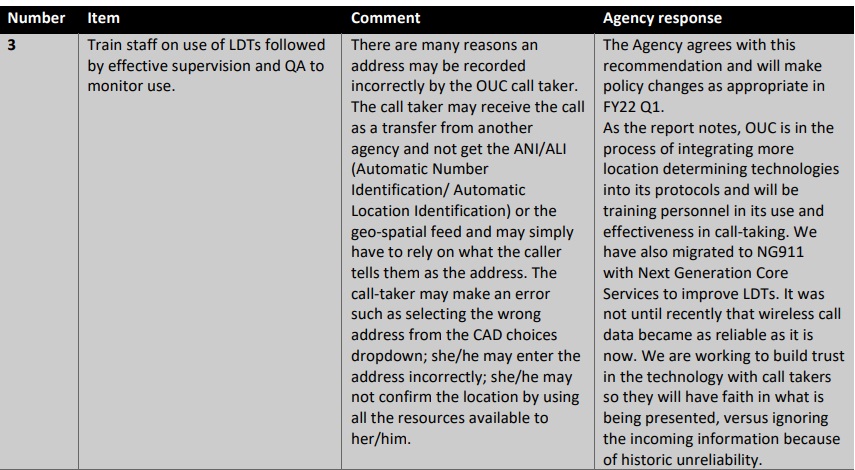
Another chronic problem at DC911 is call-takers mistakenly choosing the wrong address from auto-populated drop-down menus when they enter a location into the computer. One example of this was a year ago when DC911 dispatched a building fire call to 1100 East Capitol Street NE instead of 1100 Eastern Avenue NE. This caused an eleven-minute delay as a mother and baby hunkered down in a smoke-filled bedroom while a small fire burned in their kitchen. Accurate LDT information on that call was available and ignored.

The feedback dead-end
STATter911 has submitted an OUC Feedback Form for each of the blown addresses on Memorial Day. In fact, STATter911 has now filled out 26 of these forms since the beginning of the year. Despite a standard promise of a follow-up within 48 hours, no one at OUC has contacted STATter911. OUC’s leadership and public information officer stopped acknowledging STATter911’s emails in 2023.
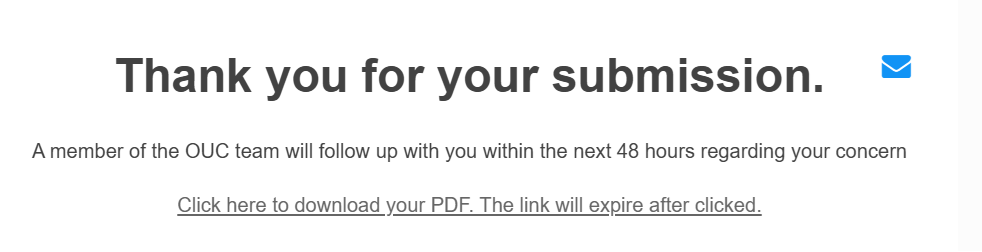
The reason for submitting the forms is not just to elicit an explanation from OUC. It’s also an attempt to make sure these issues aren’t ignored. At a February 5th oversight hearing, OUC Director Heather McGaffin testified she was unaware of the many address errors and other mistakes reported by STATter911 in 2024 and early 2025. OUC, under McGaffin’s leadership, has not included any of STATter911’s documented incidents in the legally required monthly public reporting of OUC issues posted to DC911’s Performance Dashboard.
The Secure DC Law of 2024 mandates the posting of “mistaken addresses, duplicate responses, or any other error or omission reported by the Council, other agencies, the news media, OUC staff, or other sources.” Could it be that OUC is breaking the law by failing to include STATter911’s official submissions in its monthly public reporting?

Since the hearing, STATter911 routinely uses the Feedback Form to ensure that all blown addresses and other issues are brought to the attention of McGaffin and her leadership team. Despite that, they still aren’t being posted. The legislation that’s being ignored was written by Pinto at the urging of many concerned about DC911’s performance, including STATter911.

Similarly, as STATter911 first reported in 2020, OUC continues to underreport blown addresses when responding to an oversight questionnaire submitted annually by Pinto and her predecessors. It’s hard to fathom why it isn’t a bigger deal that a crucial public safety agency is greatly underreporting key performance statistics in its official filings.
Memorial Day problems
The second incident on Memorial Day occurred at 4:15 p.m. (audio above). DC Fire and EMS was dispatched to a person having trouble breathing at 30 Gallatin Street NW. When it was determined by firefighters and medics that 30 Gallatin was not a good address on either the Northwest or Northeast side – in this case just a block apart from each other – the Fire Operations Center (FOC) stepped in. FOC, using the same computer information available to DC911 staff, discovered that not only was the quadrant wrong, but so was the street name. Fifteen minutes were lost before the closest fire and EMS units were sent to 30 Galveston Street, miles away in Southwest.
At 9:38 p.m., Engine 10 responded to a report of a loud explosion at 12th Street and Florida Avenue NE (audio above). At the same time, OUC was receiving numerous calls about an explosion heard, but they were all coming from Northwest. In this case, DC911 workers spotted the mistake, realizing this call did not originate from Northeast DC. They cancelled Engine 10 and alerted Engine 21, whose crew was already trying to track down the source of the loud noise in Northwest.
The fourth incident was at 10:38 p.m. (audio above). This was another trouble-breathing call. The initial units were sent to 1000 H Street NE. Five minutes were lost before DC911 dispatchers determined that the correct location was 1000 H Street in Northwest.
There’s a reason for the DC911 transparency law
So far this year, the official OUC Performance Dashboard shows only two wrong addresses dispatched by DC911. Both were wrong quadrants blamed on the 911 caller, with no indication whether location data was available. There is also a third call where OUC admits a call-taker failed to use LDT to get help to a woman needing police on a park trail. In fact, up until April, the dashboard acknowledges only three mistakes of any kind by OUC staff.
Anyone who listens to DC Fire and EMS radio traffic knows those are ridiculously low numbers. And anyone with even minimal knowledge of big city 911 centers knows it’s absurd to believe that of the hundreds of thousands of calls dispatched to fire, EMS, and police so far this year, there were only two wrong addresses, a single failure to effectively use LDT, and a grand total of three errors.
Just from listening to the radio traffic, along with information from sources, STATter911 has identified 14 blown addresses. That list is far from complete. Without good statistics on the real number of botched addresses and the reasons for each, it’s hard to see how DC911 will improve. Having an accurate list allows those in charge and those responsible for oversight to see the patterns in calls where there were call-taker or dispatcher mistakes.

There’s a reason many of us concerned about DC911’s problems pushed Council member Pinto to pass legislation requiring these important monthly stats. We all knew the stories of people like Shelia Shepperd. Shepperd’s 13-year-old daughter waited and waited for fire and EMS to show up while she performed CPR on her mom. The wait was so long because a dispatcher sent fire and EMS to the wrong quadrant of the city.
On Thursday, it will be five years since Sheila Shepperd collapsed and died. It took five months to get the truth that OUC botched that 911 call. And now, even with a law requiring OUC transparency, we still can’t get the truth about DC911’s mistakes.