More proof DC911 can’t handle the basics of the job
Another series of errors shows DC911 continuing to make the same mistakes
 Looking for a quality used fire truck? Selling one? Visit our sponsor Command Fire Apparatus
DC911 can’t get out of its own way. They keep making the same mistakes. Mistakes that show the staff does not have a good grasp of the skills needed for receiving and dispatching fire and EMS calls. Don’t blame the call-takers and dispatchers. As STATter911 has shown before, this is the fault of the people running the agency. This comes from poor training and leadership. Yesterday (Monday), there were three errors in just a little more than an hour that illustrate this problem.
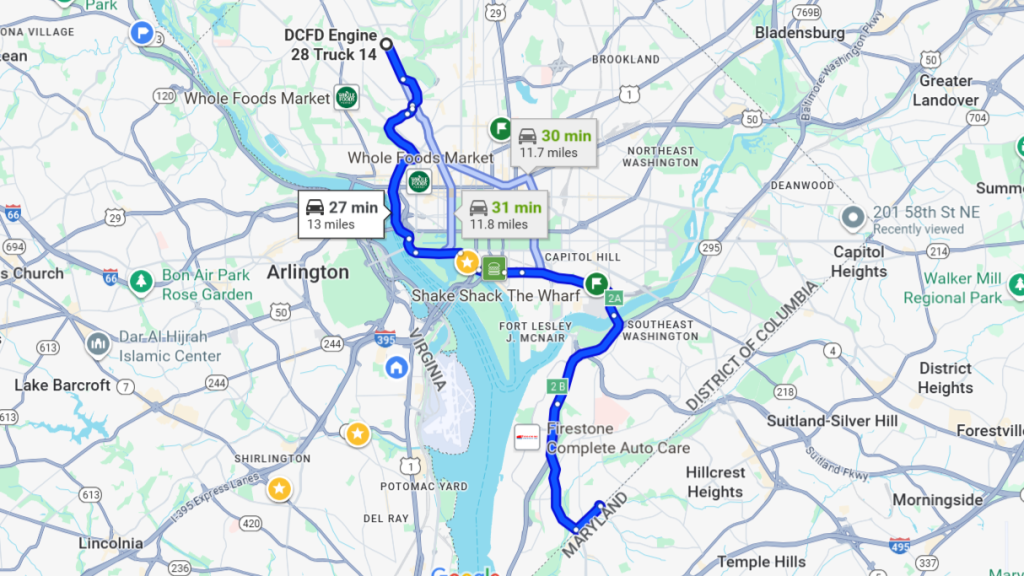
At 2:12 p.m., DC911 dispatched Truck 14 from Upper Northwest to a gas leak in the 800 block of Southern Avenue SE on the border of Prince George’s County (see the map above). That’s about as far away as you can get from Truck 14’s firehouse and still be in DC. The error was apparently caused by a known computer glitch, combined with both a lack of situational awareness and a failure to understand the city’s geography.
Here’s what happened. Moments before the gas leak response, Truck 14 was transferred to a firehouse across the city in the Capitol View neighborhood off East Capitol Street in Northeast. They were being sent there to cover for units handling a fire at the old RFK Stadium. Some insiders blame the long distance dispatch on OUC’s computer. They tell me it has been known that the dispatch computer system acts as if a transferred fire company has been magically and instantly transported to its new location and assigns responses accordingly. In reality, Truck 14’s crew was still at their Cleveland Park firehouse, about 13 miles from the gas leak.
No one inside the Office of Unified Communications apparently questioned why Truck 14 was being sent such a great distance. It took about five minutes before a dispatcher realized they had a much closer truck company to send to Southern Avenue. But wait, just 60 seconds after clearing up this mis-dispatch, the computer and the dispatchers teamed up again to make the same mistake.
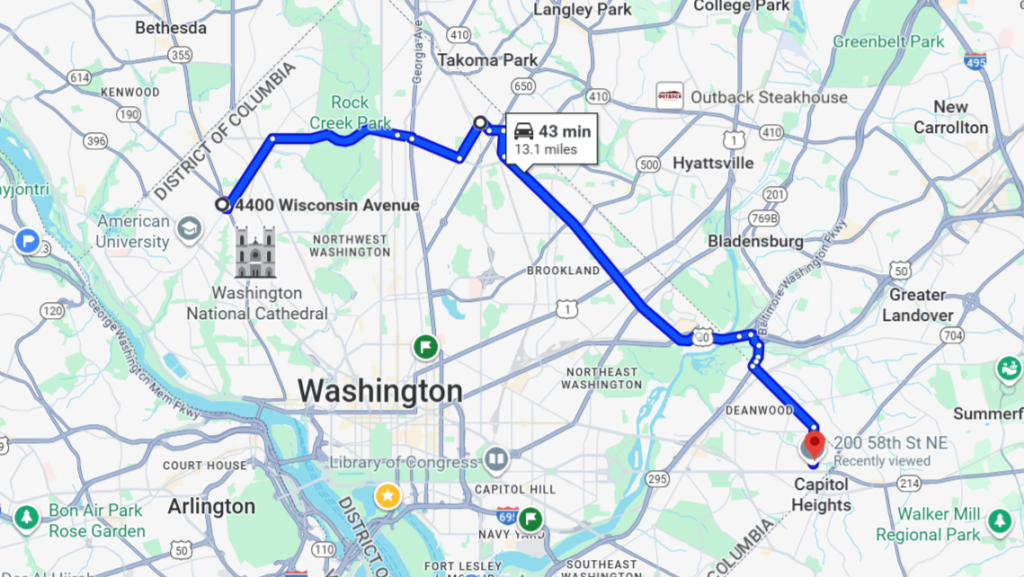
Paramedic Engine 20 from the Tenleytown neighborhood in Upper Northwest was also transferred to the same Northeast firehouse as Truck 14. At 2:19 p.m., it was dispatched as the closest unit to a sick call in the 200 block of 58th Street NE. For reference, that’s just three blocks from the DC border with the Town of Capitol Heights in Prince George’s County (map above). That’s another 13-mile ride. Once again, there was a complete lack of situational awareness, with no dispatcher or supervisor asking why Engine 20 was sent to 58th Street NE. As with Truck 14, it took the fire company to alert dispatchers to the error (radio traffic is below).
At 3:19 p.m., there was another good example of dispatchers and supervisors just accepting what they see on the screens in front of them without questioning an obvious mistake. The address 700 2nd Street NE is the location of Kaiser Permanente. The staff at the large medical complex calls 911 for an EMS response multiple times each day. It’s an address everyone working at OUC should know by heart. I do, just from listening to the scanner. Yet, somehow, DC911 dispatched a call to Kaiser Permanente with the address of 70 2nd Street NE (radio traffic is below). The mistake passed through the hands of a call-taker and was voiced by two dispatchers. It might also have been viewed by a supervisor or two. Yet, no one caught the mistake. But, once again, fire and EMS did. They also caught another error with this run. Dispatchers assigned an engine company to provide medical care until a paramedic unit arrived. That’s not supposed to be done for a call at a medical facility where medical professionals are already with the patient.
Unfortunately, this is a routine day at OUC. Just two weeks ago, STATter911 showed how call-takers, dispatchers, and supervisors kept sending emergency calls meant for the National Mall to a neighborhood five miles away. These are all chronic problems that OUC just can’t get past.
None of these errors will likely be reported as required by an OUC transparency law. The council member who wrote that law and leads oversight of the agency says it’s okay for OUC’s director to ignore any mistakes reported to them by STATter911. That’s because the OUC Feedback Forms I fill out don’t include the 911 caller’s phone number (the video is below).
Brooke Pinto mistakenly believes that it’s too hard for OUC to investigate an error without having the 911 caller’s phone number. She says OUC is too busy to spend time investigating mistakes where the caller’s phone number isn’t provided. Pinto says she believes this is accurate because that’s what OUC’s leadership told her.
This lack of critical thinking by the council member and her willingness to accept a laughable explanation as gospel is an excellent example of the level of oversight Pinto has provided and is likely to provide in the future. In other words, don’t expect any real solutions for OUC from Brooke Pinto. She has become a major roadblock to OUC reform and a significant part of the problem with DC911.