DC911: More blown addresses. New rules to help hide mistakes.
DC911 leaders post rules allowing them to ignore dozens of errors reported by STATter911

Looking for a quality used fire truck? Selling one? Visit our sponsor Command Fire Apparatus
Two times within three hours over the past weekend, DC911/OUC sent firefighters, EMTs, and medics to the wrong address. One of the calls was for a reported cardiac arrest, where more than ten minutes were lost. In both cases, a dispatcher initially tried to blow off the firefighters who alerted OUC that mistakes were made and that closer fire and EMS units should be dispatched. These errors occurred as agency leaders officially changed how they accept complaints from the public. The new rules limit who can inform OUC about blown addresses and other mistakes. This policy has the blessing of the DC council member in charge of OUC oversight, providing a significant blow to transparency.
Blown addres #1
At 8:47 p.m. Saturday, DC Fire and EMS Department Engine 7 was dispatched to the 300 block of Tingey Street SE for a sick person (OpenMHz radio traffic above). That address is in the middle of the Navy Yard neighborhood. While responding to the call, the officer in charge of Engine 7 noticed something odd on the computer screen in front of him. Without warning from dispatchers, the address was changed to a location far away. The screen showed Engine 7 should have been responding to Wisconsin Avenue in Upper Northwest, to a building in Tenleytown housing the Psychiatric Institute of Washington. That address was more than eight miles away. It’s unclear how the two addresses, with no obvious connection, could have been mixed up.
Engine 7’s crew knew there were plenty of fire and EMS units much closer to Tenleytown. Calling on the radio channel assigned by OUC, the officer tried to alert the dispatcher to the address change. In a well-functioning 911 center, the dispatcher should be alerting the units in the field to address changes. Instead of acknowledging Engine 7 catching this problem, and assuring them that the call was being re-dispatched, the dispatcher tersely responded, “Operate on the correct channel, Channel 12.”
The dispatcher was essentially saying the emergency call was no longer her problem. EMS calls in Northwest are usually handled on a different channel and by a different dispatcher than those in Southeast. Apparently surprised by the dispatcher’s reaction, Engine 7 made sure the dispatcher understood why they were calling and tried to explain further. Without even acknowledging that they understood the issue with this call, the dispatcher again said to switch to Channel 12. On Channel 12, there was a completely different response from OUC. Even before Engine 7 could get out the message, the new dispatcher recognized the problem and immediately dealt with it.
Blown address #2
The second blown address was potentially a more serious call (radio traffic above). Three fire and EMS units were dispatched to the 900 block of 5th Street NE for a reported cardiac arrest. Losing time on such a call can mean the difference between life and death. Engine 3 was at the address on 5th Street NE searching for a patient along with police officers. No one was found, but the officer in charge of Engine 3, like his counterpart at Engine 7, noticed something new on the computer screen. The address had been changed without OUC notifying responding units. The new address was the 900 block of 5th Street in Southeast, not Northeast.
Engine 3 called by radio. They asked if they were in service since there are other fire and EMS units closer to the new address. Instead of taking responsibility for the problem and fixing it, a dispatcher responded, “If you’re on the scene, use your discretion.” It took a second explanation by Engine 3 before OUC confirmed the address change and put Engine 3 and the other units in service. A new dispatch with the closest units came ten minutes after the initial response. Luckily, this patient was not in cardiac arrest when help finally arrived. They were conscious and alert.
OUC doesn’t want to know about its mistakes
This is the 27th time this year that STATter911 has learned of OUC sending fire and EMS to a bad address. My list, along with more than 20 other delay-causing DC911 mistakes, is considerably more extensive than the list of reported errors that OUC is required by law to post publicly. Each is documented with radio traffic and additional information. In recent days, OUC published new rules, officially creating obstacles to prevent STATter911 and anyone else not directly involved in a 911 call from alerting the agency’s leaders to blown addresses and other errors. Sadly, it’s likely that a public statement by DC Council member Brooke Pinto encouraged this rule change that helps OUC hide its mistakes from the public and the council.

OUC appears to have posted its new online Feedback Form rules because STATter911 continues to use that tool to notify the agency’s leaders of potential errors. It’s part of my efforts to show that OUC is breaking the law by failing to post most of these incidents online each month. Last year’s Secure DC Act – written by Council member Pinto – says OUC is to make public, “Descriptions of each call-handling issue, including mistaken addresses, duplicate responses, or any other error or omission reported by the Council, other agencies, the news media, OUC staff, or other sources.”
STATter911 began filing the forms in January after listening to OUC Director Heather McGaffin’s sworn DC Council testimony last year. McGaffin claimed during a hearing that she was completely unaware of a lengthy list of blown addresses and other problems I had both published and submitted to council members. Filing the forms is my way of keeping OUC’s director informed of what’s happening inside the 911 center she runs.
The forms serve another purpose. Long ago, OUC stopped responding to my emails, insisting that I file a Freedom of Information Act request to learn any details about 911 calls. The FOIAs, as we’ve previously reported, are then denied because of OUC’s dubious privacy claims (a policy OUC also reiterates in its new Feedback Form rules).
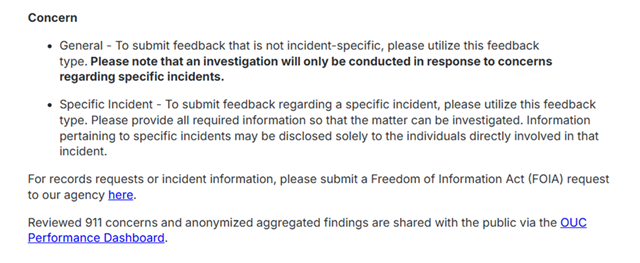
Until now, I have filed all of the incidents using the form for general complaints rather than the one for “specific incidents”. The reason is that the online form for specific incidents requires the phone number from the 911 caller. It can’t be filed without that information. A 911 caller’s number is normally unavailable to me and the rest of the public. In fact, at a June public hearing (see video below), Pinto told me that because my reports don’t have that phone number, she is fine with OUC ignoring my complaints. Pinto mistakenly believes that it’s too difficult for OUC staff to investigate an incident without the phone number. Numerous current and former 911 workers and administrators from DC and elsewhere say such a claim is ridiculous. They confirm that the address, time, date, units responding, and radio traffic I provide are more than enough to promptly find an incident.
Now, OUC has put Pinto’s words into action on the agency’s website. It says investigations will only be conducted in response to the specific incident form, the form requiring the 911 caller’s phone number.
What it all means
Despite the rules, I’ll continue to alert OUC and Pinto’s office about these troubling 911 problems, mostly using the only avenue available, the “general” Feedback Form. Also, for the first time, I submitted two of the specific incident forms last week for botched addresses where I obtained the phone numbers of two 911 callers. We’ll see how that goes.
Though it would be nice, none of this is meant to elicit a specific response to STATter911. If they don’t want to talk with me, that’s their problem. My goal is very simple. It’s to force OUC to finally publish accurate lists of delayed dispatches and other calls. Since 2020, STATter911 has proven OUC consistently underreports errors in official responses to the DC Council and, more recently, on the Performance Dashboard.
It’s clear Director McGaffin and Council member Pinto don’t consider STATter911 either the “news media” or “other sources” as outlined in Pinto’s Secure DC Act. Trust me, I wear that as a badge of honor. But denying I exist, and rigging complaint forms means OUC doesn’t have to investigate and then post dozens of problem 911 calls. It also means some of the official statistics and information provided to the public and the council are bogus. You can’t fix 911 without accurate data that helps identify the problems.
In addition, the public deserves a 911 center that openly and accurately acknowledges its mistakes and what it’s doing to address them. Instead, the news media, the public, loved ones, and even council members can’t get the truth. The worst part about this continuing cover-up is that it’s aided and abetted by Brooke Pinto, the person whose job is to keep them honest. That is shameful.