Looking for a quality used fire truck? Selling one? Visit our sponsor Command Fire Apparatus
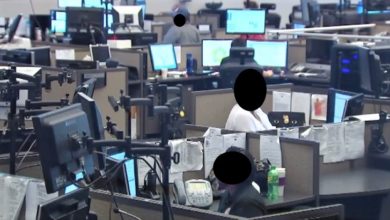
The pictures on this page show workers at Washington, DC’s 911 center using the agency’s computers to play games and shop. The images were sent to STATter911 by DC911 employees who say they’re upset with co-workers who aren’t focusing on their duties and supervisors who fail to address these distractions. They are also unhappy with the many mistakes that occur at DC911. The pictures are reported to have been taken this year during day shifts when Office of Unified Communications (OUC) top management is often in the same building.
On the overnight shift, the stories from inside DC911 add additional information about what some employees are doing on the job. While there are no pictures to share, multiple sources say that there is regular sleeping at work stations and employees playing games together.
The pictures and information were received as responses to STATter911 recently asking how it was possible that DC911 workers badly botched a cardiac arrest call earlier this month. As STATter911 previously reported, there were serious mistakes made at OUC during the December 2nd response. These include dispatchers not promptly sharing important information about the patient’s status with DC Fire & EMS crews and failing to respond to multiple radio transmissions.
The delay in getting help to the patient happened at 5:15 a.m., a relatively quiet time of day. Radio traffic (below) shows that dispatchers didn’t tell firefighters and medics until about 20 minutes into the call that their patient, home alone and having trouble breathing, was no longer responding to a call-taker’s questions. It was crucial information that prompted firefighters to immediately force entry into the person’s locked apartment.

It’s unclear how long it was known that the call-taker still had the phone line open with no answer. What is known is there was a delay for at least four minutes because dispatchers failed to answer firefighters and medics calling on the radio requesting more information about the 911 caller and their address.
Dispatchers not answering emergency radio traffic is a chronic OUC problem that STATter911 has documented since 2020. It has happened at least nine times this year alone. 911 staff STATter911 has talked with claim radios went unanswered in the past because dispatchers dozed off. It’s not clear if that happened on this call.
The information STATter911 sought wasn’t necessarily specific to the December 2nd incident. It was an effort to understand why so many DC911 errors occur. All of those providing information and images to STATter911 asked that they not be identified for fear of retaliation. While some OUC insiders claim the handling of the recent cardiac arrest call fits the pattern of distracted and sleepy 911 workers, STATter911 has been unable to independently verify what occurred on the operations floor during that call. What STATter911 has confirmed is that there is a consistent issue of some 911 staff sleeping on the job, playing games, and surfing the web instead of focusing on their crucial work. All of it appears to go against OUC policy.
The games people play
The pictures on this page, which have been altered by STATter911 to hide identities and 911 call information, appear to show on-duty call-takers. Their identities and roles at OUC have been independently confirmed. The various computer screens in front of the call-takers show maps and information related to handling 911 calls.

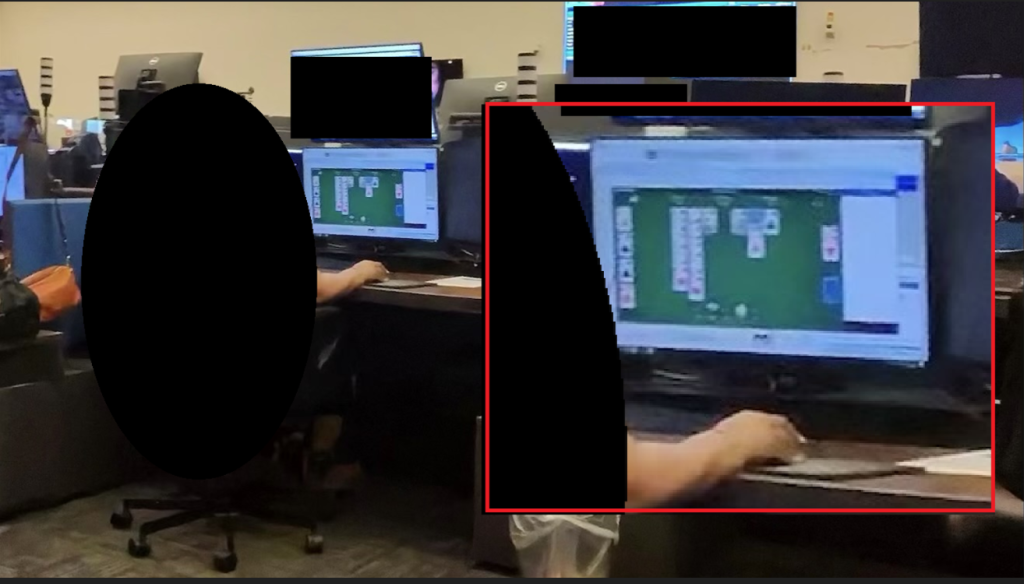
In one picture, the left computer screen shows the buttons a call-taker uses to forward a 911 call to neighboring jurisdictions or internal groups such as the nurse triage line. The screen immediately to the right shows a computer driving game. The game takes up the entire screen. Another image shows a similar setup with a worker playing computer Solitaire. A third 911 worker is pictured looking at a website selling women’s clothing in what appears to be the active window of the computer screen. Additional windows on the same screen show a street map and other 911-related information. A second person is sitting just behind this call-taker, watching as the call-taker appears to shop for clothing.


The distractions are not all computer-based. The sources say that some 911 workers will sit back from their computer screens in an aisle and play the card game UNO during slow periods.
OUC policy
OUC cut off communications with STATter911 long ago, so OUC’s current policies or comments aren’t immediately available. Obviously, sleeping at positions on the 911 center’s operations floor is supposed to be prohibited. We do have some insight about computer use from OUC Director Heather McGaffin’s testimony during a June DC Council hearing (below). McGaffin said then that cell phone use and web surfing aren’t allowed. She indicated that some other non-screen activities are permitted during slow times.
“The things that we encourage our staff to do, and this is an industry best practice, are things like puzzles, which there are plenty of coloring cards, things that aren’t really screens,” McGaffin testified. “Now, they can access Google because restaurants change names, and if folks say, ‘I’m at this restaurant,’ and that might not be in the CAD system yet, then we might have to Google an address. But a lot of the things, no one’s surfing the web per se, because there’s a lot of websites that are completely shut down to that kind of thing.”
Consistent with McGaffin’s testimony, it should be noted that it’s possible that some of the websites seen in the posted images have since been blocked and may no longer be available on OUC’s computers. The sources say that other similar sites and games are still accessible from workstations on the operations floor.
According to McGaffin’s testimony, cell phones are banned because of security concerns around the sensitive information OUC shares with police that comes from the National Crime Information Center (NCIC) and the Washington Area Law Enforcement System (WALES). OUC sources claim that in reality, the no cell phone policy isn’t strictly enforced.
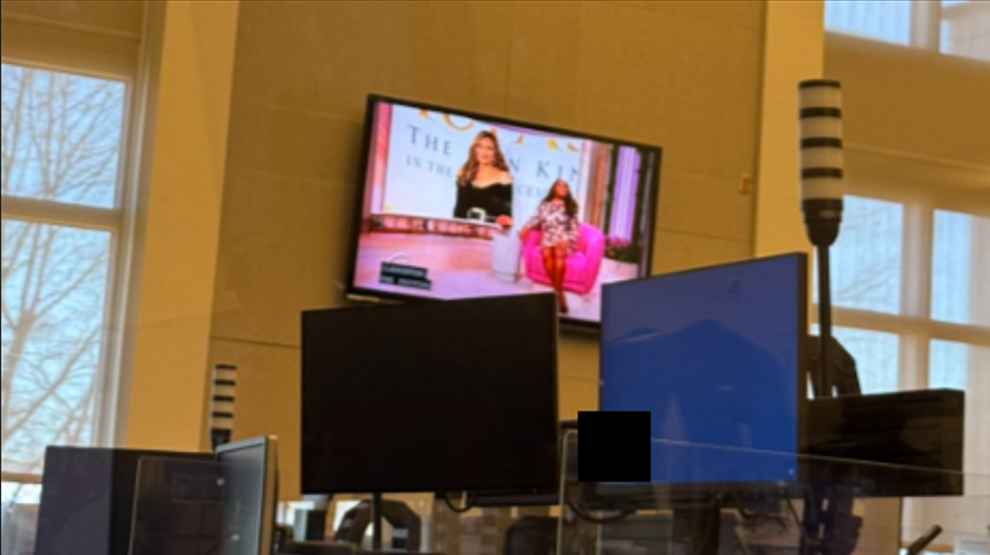
McGaffin said there are televisions running at OUC without sound, mostly showing news and sports events. It’s unclear if the TV programming captured in the picture below fits McGaffin’s description of what can be viewed.

Where is the supervision?
The sources claim that the sleeping and game playing occur in front of some of the agency’s shift supervisors. They also say that none of this should be a surprise to OUC’s leadership. OUC upper management has the ability to monitor all of this through cameras that constantly record actions on the operations floor.


The 2021 audit of OUC through the Office of the DC Auditor was critical of the role of supervisors. The report pointed out that OUC policies were inconsistently applied by the various supervisors, saying, “Enforcing policies requires alert supervisors.” The report also cited, “A lack of dedicated and present supervision on the operations floor.”
In follow-ups to the audit, OUC claims to have made improvements in the supervisory staff. People currently working at OUC describe those efforts as mixed. They point out that, as the audit found, policies are still inconsistently applied and there is still at least one police-side supervisor in charge of fire and EMS dispatching.
Others tell STATter911 that some supervisors have additional duties that conflict with their time on the operations floor. More than one OUC worker wants to see supervisors use some of the slower time where workers are playing games and sleeping to lead refresher drills on geography and OUC procedures.
Fact: OUC underreports mistakes
The pictures and information from the 911 operations floor come at a time when mistakes continue to plague OUC. For example, the failure to monitor emergency radio channels has been a chronic problem for more than five years. It happened again on Saturday (below), marking the ninth time this year that STATter911 documented an unmonitored DC Fire and EMS radio channel.
Since Heather McGaffin took over the agency three years ago, STATter911 has reported that radios weren’t answered at least 23 times. Despite radio traffic confirming each of these incidents, the vast majority aren’t acknowledged by OUC and its director.
In a February response to an annual DC Council oversight questionnaire, McGaffin wrote that these incidents “are posted on the agency’s Performance Dashboard when they are discovered.” No such incidents have been posted to the site by OUC this year, and there were only two each listed for 2024 and 2023.
Similarly, STATter911 was made aware of and documented 32 instances this year where the DC Fire and EMS Department was dispatched to a bad address. While DC law requires such incidents to be reported monthly, OUC’s Performance Dashboard identifies only nine times this year where firefighters, medics, and EMTs were sent to the wrong location.
Brooke Pinto’s inconsistent messaging on stats
You might think that underreporting performance stats would be a problem for an agency director when it comes to oversight by the DC Council. That’s not the case with OUC. During a June hearing (above), Council member Brooke Pinto made it clear that the incidents documented by STATter911 do not have to be reported or investigated by OUC because they don’t include the 911 caller’s phone number. Of course, the 911 caller’s phone number is something tightly held by OUC and usually not available to reporters or the public.
The 2024 Secure DC Law, written by Pinto, says nothing about needing a 911 caller’s number as a requirement for the reporting of potential errors. What it does say is that “mistaken addresses, duplicate responses, or any other error or omission reported by the Council, other agencies, the news media, OUC staff, or other sources” are to be shared publicly every month. In testimony, Director McGaffin has said OUC complies with the Secure DC Law.


After Pinto’s June remarks, OUC codified her words with official policy. The OUC Feedback Form on its website now requires the 911 caller’s number to report a problem about DC911’s handling of a call. STATter911 sent OUC and Pinto’s office dozens of Feedback Forms this year before the policy change. All were ignored.
Even when STATter911 followed the new rules, OUC failed to obey the law. Two blown addresses from September were submitted with the 911 callers’ phone numbers. The information was supplied by sources familiar with the calls. Neither incident has been listed on the Performance Dashboard.
Pinto, who chairs the Committee on the Judiciary and Public Safety, has a different view of providing the council and public with accurate statistics when it comes to another of the committee’s public safety agencies. Last week, in a letter about the recent controversy over the possible downgrading of crime statistics by the Metropolitan Police Department, Pinto wrote, “accuracy in reporting crime statistics is critically important for public trust and for assessing the effectiveness of our public safety interventions.”
STATter911 first reported on questionable OUC stats submitted to the DC Council in 2020. Pinto’s committee has oversight of both DC Police and DC911/OUC.
So, what happened?
Were 911 workers sleeping or playing games instead of focusing on answering the radio and promptly relaying crucial information? Or were the mistakes of December 2nd simply due to poor training or other issues?
If history is a guide, we may never know why the response to the cardiac arrest was so poorly handled. That’s because OUC has always been allowed to investigate itself. STATter911 reporting has shown over the last six years that OUC has covered up the facts surrounding many of its most serious cases, including other botched cardiac arrest calls.
What we do know is that the small number of errors OUC publicly reports is not the reality. We also know that the picture the director paints about what goes on inside DC911 is very different than the pictures you see on this page and the information some of her workers are sharing with STATter911.