When ambush journalism replaces basic fact-checking
Sen. Lindsey Graham was alive when medics reached him. That fact and others were missed by a reporter who ambushed the staffer who called 911.
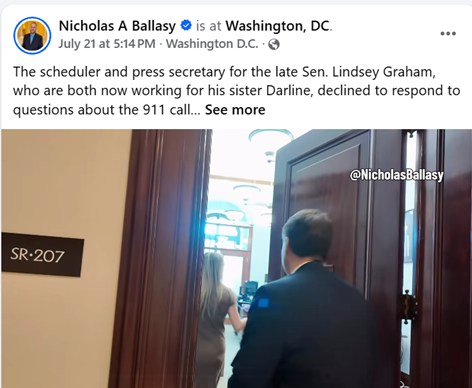
Watch flawed story on emergency response to Sen. Lindsey Graham’s home
Journalism at its best provides clarity during a crisis. At its worst, it transforms human tragedy into lazy clickbait. A July 21st news report (watch here) covering the death of Senator Lindsey Graham is a masterclass in the latter. The story was built on a foundation of factual errors about Graham’s July 11th death. It culminates with ambush interviews of grieving Capitol Hill staffers, including the woman who called 911.
It’s not just the cruelty of chasing someone down a hallway who recently experienced severe trauma; the story’s core premise collapses under basic scrutiny.
Helping to fuel some of these errors is the reporter’s assumption that Senator Graham immediately required CPR when fire and EMS crews found him. He didn’t. Four sources familiar with the events of that evening tell STATter911 that Graham didn’t lapse into cardiac arrest until about 15 minutes after paramedics began their assessment and treatment.
The news report is the work of Nicholas Ballasy, a reporter on Capitol Hill. I reached out to Ballasy through email and social media direct messaging. My hope was that he would correct or remove his report. He never responded. Below is the information I shared with Ballasy about his mistakes.
Misidentifying the source material
Ballasy claims at the start of the report that his information came from the 911 call. It did not. It’s from DC Fire & EMS radio traffic (below).
Obtaining actual 911 recordings from DC’s notoriously opaque Office of Unified Communications is a difficult feat. I would be writing in admiration if he obtained the 911 call.
Mistaking public dispatch traffic for the initial 911 recording isn’t just a minor technical blunder — it misleads the audience about what was actually said and who said it.
In fairness to Ballasy, he is not alone with this error. The same mistake was made by numerous national news organizations immediately following Graham’s death. If it were the only error, I wouldn’t be writing this column.
Inventing a “scandal” over an unlocked door
Ballasy sets up his hallway ambush around a supposed critical discrepancy: the staffer told 911 the front door was unlocked, but responding crews found it locked.
Manufacturing a scandal out of this detail ignores basic human behavior under extreme stress. Common sense offers several obvious and logical possibilities:
- Senator Graham told his staff member the door was unlocked.
- Senator Graham said he would unlock the door but was unable or forgot due to his critical medical condition.
- The staffer simply miscommunicated.
Whatever the explanation, it had no impact on the outcome. Firefighters and EMS crews do not blindly trust initial reports before breaching a residence. They do exactly what was done during the response to Senator Graham’s home. They verify entry conditions with dispatchers to ensure they have the correct address and aren’t breaking into a home where someone can open the door.
Misunderstanding EMS basics
The reporter makes the point that “it took a while before CPR was performed — about 25 minutes.” Factually, this is close to being correct. It’s the implication that’s wrong. As I pointed out earlier, there was a very important reason CPR didn’t begin earlier: the patient didn’t need it.
It is not unusual for critically ill or injured patients to transition into cardiac arrest while being treated by firefighters, paramedics, or even in a hospital emergency department. It’s a common enough scenario that there is a specific protocol for a cardiac arrest witnessed by medics versus one that occurred before their arrival.
Furthermore, if the reporter was more interested in understanding the evidence he had than creating a moment for the cameras, he might not have messed this up. A careful listen to the radio traffic and reading of the timeline provides important clues that should have prompted further investigation:
- At 8:35 p.m., the officer in charge of Engine 7 confirmed the need to force entry and said they would be doing so. For firefighters, breaching a residential door like this is something that usually takes seconds and not minutes.
- At 8:53 p.m., the same officer from Engine 7 reported that “CPR is being performed, now.” The key word is “now”. This moment is also about 18 minutes after firefighters and medics decided to force entry, not 25 minutes.
The day after Graham died, I brought up the possibility that he coded in front of fire and EMS as the most likely explanation for what occurred between the two radio reports. Just because there were no radio transmissions from the crews for 18 minutes doesn’t mean the firefighters and medics weren’t with the patient assessing his condition and beginning treatment. Based on social media comments, it was clear that a lot of people, including reporter Ballasy, made the wrong assumption from listening to the radio traffic.
The third party call
Ballasy’s question to the staffer and his news report give the impression that there is something wrong or even sinister about her calling 911 instead of Graham doing it himself. 911 centers get third-party calls like this each day. I even did it for a loved one years ago after telling them to hang up and call 911. I wasn’t sure the person would remain conscious, so I called too.
The staffer might have had the same concern about her boss. Based on what we know about Graham’s medical condition, that was a legitimate consideration. It’s also not unusual for people experiencing a medical ailment to reach out to someone they know for reassurance that calling 911 is the right thing to do.
A fellow senator told reporters Graham wanted the staffer to make the 911 call. Lindsey Graham was a well-known public figure. The reason for asking a staffer could be as simple as not wanting the public to hear him in distress. It’s very likely Graham didn’t know about DC911’s policy of denying open records requests for 911 recordings. That’s not the case around the rest of the country.
Journalists need to do better than conspiracy theorists
In less than a month, DC Fire & EMS crews handled the hospitalization of two veteran GOP senators. You can find numerous reckless conspiracy theories surrounding both cases. Such damaging speculation erodes public trust in the federal government, the news media, and even public safety agencies. Adding a journalist’s factually broken coverage to the discussion ignites further suspicion instead of providing clarity.
There may be a legitimate news story in speaking with the staffer who made the 911 call. A sober and thoughtful interview with one of the last people to talk with Senator Graham might answer lingering questions. But cornering a traumatized staffer in a hallway to grill her on manufactured inconsistencies is not journalism. It’s sensationalism masquerading as accountability.